A Burning Candle
Would you die for Jesus? A number of the founders of our Reformed Anglican faith did just that. They were burned at the stake. We are indebted to their faithfulness, and challenged to be as faithful as they were. Our own Rev. Dr Colin Reed writes:
Have you watched the TV series on the Tower of London? In the 1550s several Anglican bishops were imprisoned there for their part in the Reformation. To understand those times we need to appreciate the interconnection between religion and politics. Religion was not seen as ‘private’; as part of loyalty to the nation everyone was expected to be a member of the official state church. King Henry VIII’s first wife was Spanish and Catholic; her daughter, Mary, became Queen after the death of Henry’s son, Edward VI. It was during his brief reign that the Reformation flourished in England. However, there was a threat on the horizon.
Queen Mary married the King of Spain and determined to take Britain back to the Catholic Church. She forced Parliament to apologise for passing laws ‘against the supreme authority of the Pope’s holiness’ and to repeal them. She sought to remove bishops, clergy and lay people who supported Reformed, Biblical beliefs. A few bishops fled to Europe, others were deposed, some went to the Tower and to their deaths.
Bishop Hooper was burned at the stake in front of his Cathedral in Gloucester; a ‘pardon’ was put before him; if he took it up the fire would not be lit. He chose to die.
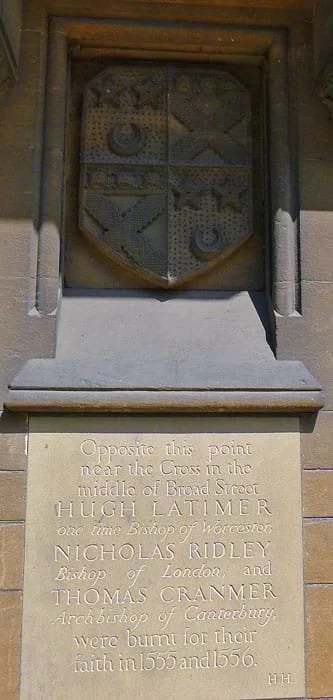
The two whose deaths are best remembered were Nicholas Ridley and Hugh Latimer. As a flame was put to the kindling, Hugh Latimer turned to his friend and said, ‘Be of good cheer, Master Ridley, we shall this day light such a candle, by God’s grace, as I trust shall never be put out’. A metal plaque in the pavement in Oxford marks the spot and date, 16 October 1555. A few months later, in March 1556, the writer of our Anglican prayer book Archbishop Thomas Cranmer was burned.
May we be part of keeping the candle of Biblical Faith burning 500 years later.
Grace and peace,
Mark